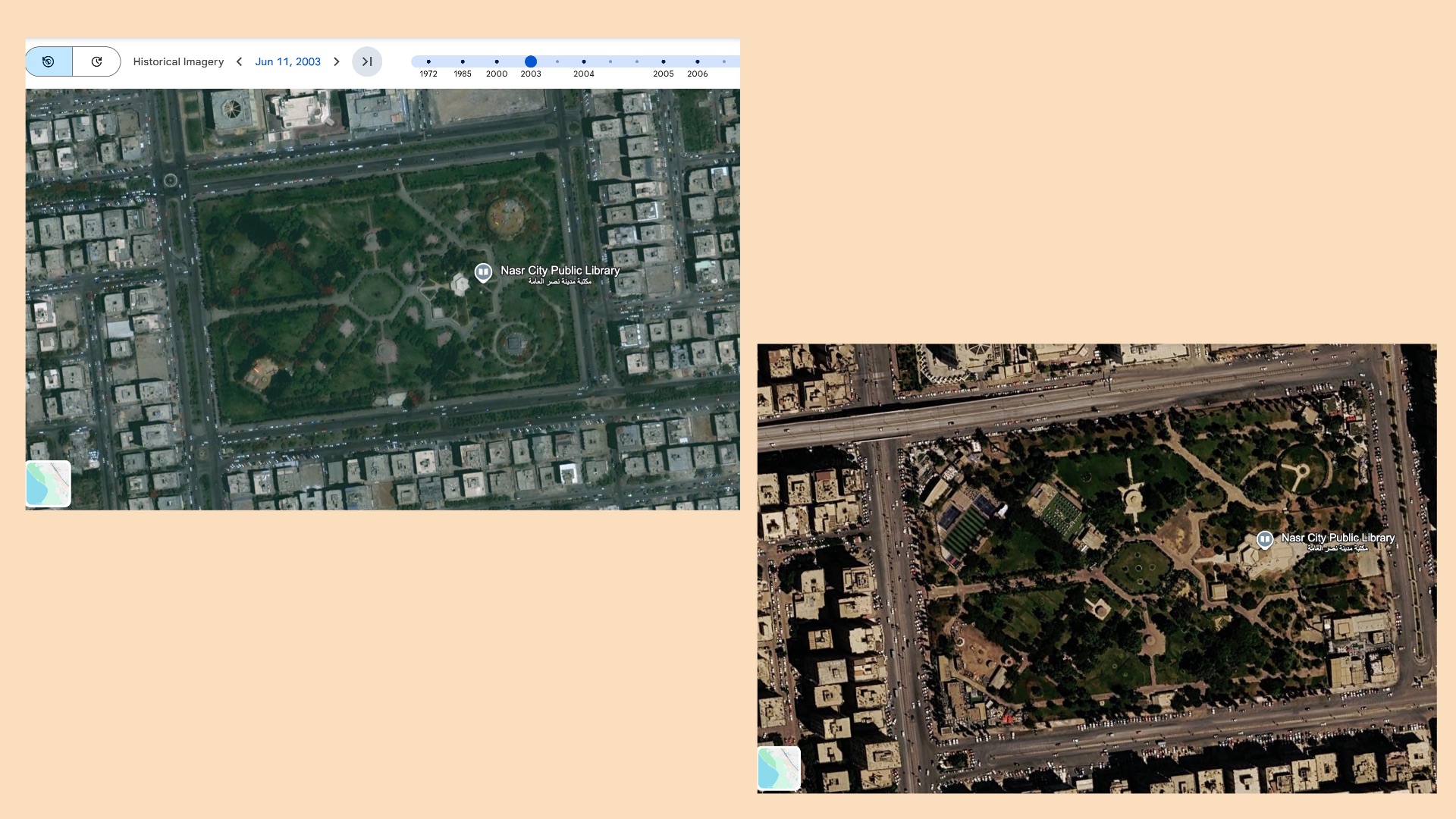
A before and after picture of the park after "development, using Google Earth historical imagery, showing a snapshot from 2003 and another on from 2026. All rights reserved to Google Earth, this is for illustration purposes only
Mourning Invisible Bodies
This essay was originally published in Mada Masr, 6 September 2026
By: Abdelrahim Eissa*
This text was translated from Arabic using Gemini AI with minimal human editing
This text addresses sensitive topics such as self-harm, death, and drug use, which some readers might find disturbing .
I wandered around the perimeter of the park, astonished by what is called its "development"—a word that has seen rampant use over the past decade, and which most often signifies the destruction of the intricate layers of physical and symbolic meaning inherent in things, transforming them into a garish, cheap, consumerist hell. No less than a quarter of a public park—given the extreme scarcity of public parks in Egypt—had its trees cut down, its grass bulldozed, and its plants removed to make way for those endless, prefabricated cubes of coffee shops and fast-food joints. I wonder who will mourn those trees. Do those who tore down the trees know that one day they embraced the sorrows and anguish of hundreds of the cruel city’s residents with a faint tenderness, one that is neither understood nor felt except by those who lived alongside the trees and listened intently?
The trees listened to my personal tragedies and anxieties, as they did for many others. They were not merely a private space in a city where privacy is scarce, but a safe haven for thoughts that had long kept me awake and tormented me. I was horrified when I saw the trees being cut down and uprooted. My heart broke for the delicate remnants of a merciless city, of political regimes devoid of even a shred of pity, and of ever-worsening cruelty. Those trees were the companions of my adolescence, and of a hopeful yet wretched youth, uprooted by a system that sees in us nothing more than culprits, or a burden undeserving of compassion or justice.
I often wonder what happens to trunks, roots, and bodies that perish, are uprooted, tortured, convulse, and collapse while no one sees them, or while many pretend they do not exist, or that their existence is of no consequence, or—in the cruelest case of all—that their absence is preferable.
I hesitated for a long time before going with a group of friends to that park after its "development." I cannot accept this new reality, nor this new relationship with my immediate surroundings in the city. The garden is crowded now, teeming with people who have come to sip poor coffee and even poorer fast food. Consumption—fast, harsh, sometimes cheap and at other times exorbitantly expensive—has become the sole form of engaging with the city and its spaces. The city is no longer ours, and its spaces have transformed into an endless series of bridges and highways, flanked on both sides by cafes and shops in a terrifying, oppressive blend of black, gray, glaring colors, and obnoxious lighting.
The conversation drifted to someone, and one of those present simply said to me, "Didn't you know? He passed away." This was the third person under thirty whose news of death I had heard in less than a month. We all pretend to be shocked, and we pretend not to know the cause of his death, even though the most likely cause was an overdose.
Over the past decade, the number of victims of substance abuse within the queer community has increased noticeably, to the point where I no longer remember this sheer volume of fatalities among those younger than me due to excessive use.And this is merely within my immediate social circle. Of course, drug use is not confined to the queer community; we have seen how it has destroyed, and continues to destroy, communities from the far south of Egypt to its north. What makes the deaths within the queer community a far more bitter experience is the silence, the pretense of denial, and the feigned shock.
Mind-altering substances in their contemporary form—even if they appear to be an individual "preference," a psychological flaw, or a negative coping mechanism—are quintessentially a cross-class social phenomenon. They cannot be dismissed as individual deviance. Rather, in their latest manifestations, they are an extension of the rave culture of the financially affluent classes, or what I call "freedom acquired through celebration." In its recent manifestation within the queer community, it mostly appears as a bourgeois symptom—as empty as it is fatal. I recall how every party I and my friends attended from the mid-2000s onward featured some form of recreational drug. These were what are termed "social drugs" (such as MDMA, a drug so famous that Madonna named an album after it in an abbreviation evoking the drug's name), which enhance the party experience and induce what is medically known as an empathogenic effect (an increase in empathy and feelings of pleasure). The queer community, known for its penchant for excess, embraced drug culture with enthusiasm, even contributing to its development by introducing new types of drugs, each more controversial than the last (such as GHB, or gamma-hydroxybutyrate, a central nervous system depressant; ketamine; and more recently methamphetamine, a stimulant). And as is expected of excess, these drugs are usually mixed together, leading to effects that are not completely understood and, in many cases, difficult to treat in instances of overdose or addiction (with the exception of methamphetamine, which has been widely studied as an illicit substance).
In general, over the past ten years, the queer community in Egypt has witnessed an expansion in drug use reaching all social classes, especially with the declining cost of certain types of these drugs and the ease of their manufacture, leaving behind devastating effects on everyone [2].
Even escaping reality and negative coping mechanisms are punished and commercially exploited under this system. This comes alongside a historical decline in public health allocations over the past decade, leaving the question: where do the state's billions go if not toward the health of its citizens?
There is a genuine difficulty in writing about a group of people who have spent most of their lives in hiding, besieged, and constantly hunted by the wider society, which always seeks to stigmatize them or erase their existence entirely. How can I judge a group of people surrounded—indeed, drowning—in this misery?
Yet the issue is not merely about drugs; there is also a marked rise in scams and stings targeting the queer community—not by the police this time, but by various parties, including ordinary citizens who use dating apps to lure members of the queer community, then physically assault them, steal their phones and belongings, and blackmail them. This phenomenon is not new; ever since human rights organizations began documenting these cases in the early 2000s, it has become a prominent feature of queer life in Egypt. But what is new now is that this phenomenon is happening outside Cairo at an alarming rate [3].
Of course, this cannot be understood in isolation from the context of severe economic hardships that have battered Egypt since 2016, with the devaluation of the currency and the current regime's insistence on punitive economic policies that spend billions of dollars on hollow projects with no return on the lives of millions, instead impoverishing the majority in ways that were previously unimaginable (an indicator of this being the rise in infant mortality rates to their highest level in 20 years).
Crime cannot be explained in isolation from the material conditions that justify and perpetuate transgressions against the weakest and most marginalized groups. The same applies to the escalation of hate speech and crimes committed against refugees and migrants. In this context, the state exploits the state of anger and resentment, fabricating a discourse of social conservatism against the queer community, and fascist propaganda against refugees and migrants. The stranger or the outcast is made a scapegoat when most people find no avenue to address the roots of their misery. The outcast is always fair game.
Negative and self-destructive coping mechanisms often become an involuntary reaction—an attempt to destabilize this system and its weight, for as long as the party lasts and the effect of the drugs kicks in. Some might argue that this is not exclusive to the queer community or any marginalized group, but what makes this spectacle of death and self-destruction so bitter is the extent of its invisibility to the outside world. Our existence, our illnesses, our drug addictions—all are folded away into oblivion, ignored and silenced, with no way to speak of them or even think about how to truly save anyone.
Our available resources are, naturally, limited to those who can afford them (meaning private medical facilities offering addiction rehabilitation services) and those who know about them and choose to seek them out. As for the majority of people, even those with the means, they shun such interventions as a result of social stigma and fear of ostracism and moral judgment. Many are not fully aware of the need for these medical interventions, or do not know which medical facility or assistance they can turn to and how. This is alongside individuals whose lives have been ruined by drugs, who possess no resources and do not know how to ask for help.
My purpose in writing this text is not to elicit sympathy, praise, or even attract the attention of the members of the queer community themselves. On a purely human level, I am gripped by contradictory feelings toward this community, for I often feel overwhelming anger at its desperate attempts to self-destruction, or to justify its own persecution and punishment.The queer community internalizes all of society's horrid projections about it, self-loathing and seeing itself as diseased, deviant, and sinful, deserving of suffering and punishment in the most gruesome ways. How often have I heard discussions with queer individuals from various social backgrounds who pathetically justify society's contempt for them, remarkably echoing every single stereotype about them. A private Telegram group recently emerged, identifying itself as ambassadors of health awareness, psychological safety, and social peace, claiming to offer support. It tells thousands of followers that the magical solution to all their "problems" and what they are subjected to (from thefts, stings, and blackmail that can in no way be justified religiously or morally) is to return to religion and abandon homosexuality—a proposition agreed upon by hundreds of followers: that homosexuality is a sin and a crime, and that the theft, physical and psychological harm, harassment, and blackmail they endure are entirely justified within this framework.
I often wonder what can possibly emanate from those selves—despised and rejected by everyone, internalizing all this evil—in their perception of themselves and who they are. How can we possess any sense of the world around us, or of our own truth, amidst all this spite and hatred? I can imagine nothing other than damaged, wretched selves, driven desperately toward their own doom.
This is not an endorsement of social determinism, nor a claim that human beings are incapable of resisting the material and social conditions in which they grow up and face daily; rather, it is an acknowledgment that the capacity to confront all those material and immaterial structures is not available to many. Even those who possess material and class privileges (such as education, literacy, awareness, and social networks), like the bourgeois classes, rarely produce critical or even progressive stances regarding their perceptions of themselves or their value as individuals. In fact, one could argue that the culpability of the bourgeois class is uglier than all others, because it is the class that holds the capacity and resources to change consciousness and discourse in shaping its own self, yet it refuses to do so, identifying with this consumerism from a position of power and touting superficial liberal discourses about freedom or drugs without the slightest awareness or understanding of the meaning or purpose of that freedom. So while corpses pile up and trees vanish from the city as we sip our terrible coffee, what is left for us to celebrate?
Or when the party ends and whoever falls from an overdose falls, who will mourn these bodies?
Usually, the families of these unknown individuals refuse to state the cause of death. Friends and acquaintances even insist on a complete blackout regarding the cause of death, asking all friends never to speak at all of the "open secret" known to everyone. Does this fall under "speak well of your dead," or is it continuous complicity and willful blindness to the tragedy of an outcast group?
Recently, I tried contacting an organization to create a simplified guidebook on the types of drugs used, the degree of danger of each substance, and what should be done in case of an overdose, so that those who use them might know the effects of what they are consuming, in the hope that it might help someone or save another's life. I hope this guide will be published and circulated among the most affected groups.
I return to remembering the trees that were uprooted from their places—does anyone mourn their loss? And how can we mourn unseen bodies? My thoughts sometimes drift, and I imagine the uprooting of all these bridges, the stripping away of the lanes of all those highways, transforming them into endless expanses of trees. I imagine myself returning once again to that garden to retell hundreds of stories about selves killed by an excess of desire and despair, and the complicity of everyone in a prolonged moment of cruelty and helplessness.
*Pseudonym
References
[1] See psychiatry's classification of drugs according to their psychological effect.
[2] This is difficult to confirm with figures because addiction rates, according to the government, are declining, while synthetic drug use rates have risen. Data on recreational drug use is hard to obtain because official statistics typically focus on addiction and those in need of medical care or assistance. The illegal nature of recreational drugs and the social stigma surrounding them mean they are underreported. However, even with this underreporting, drug use among males aged 15 to 30 stands at 22%, which is double the global average. See the survey conducted among university students in 2022 in the World Health Organization journal.
[3] It is very difficult to obtain any objective statistics considering that most of those subjected to this type of violence or theft do not report the incident to the authorities, and in the rare cases when it is reported, it is usually recorded merely as aggravated robbery or assault without tying it to the homophobia or anti-gay motive framing the entire incident.