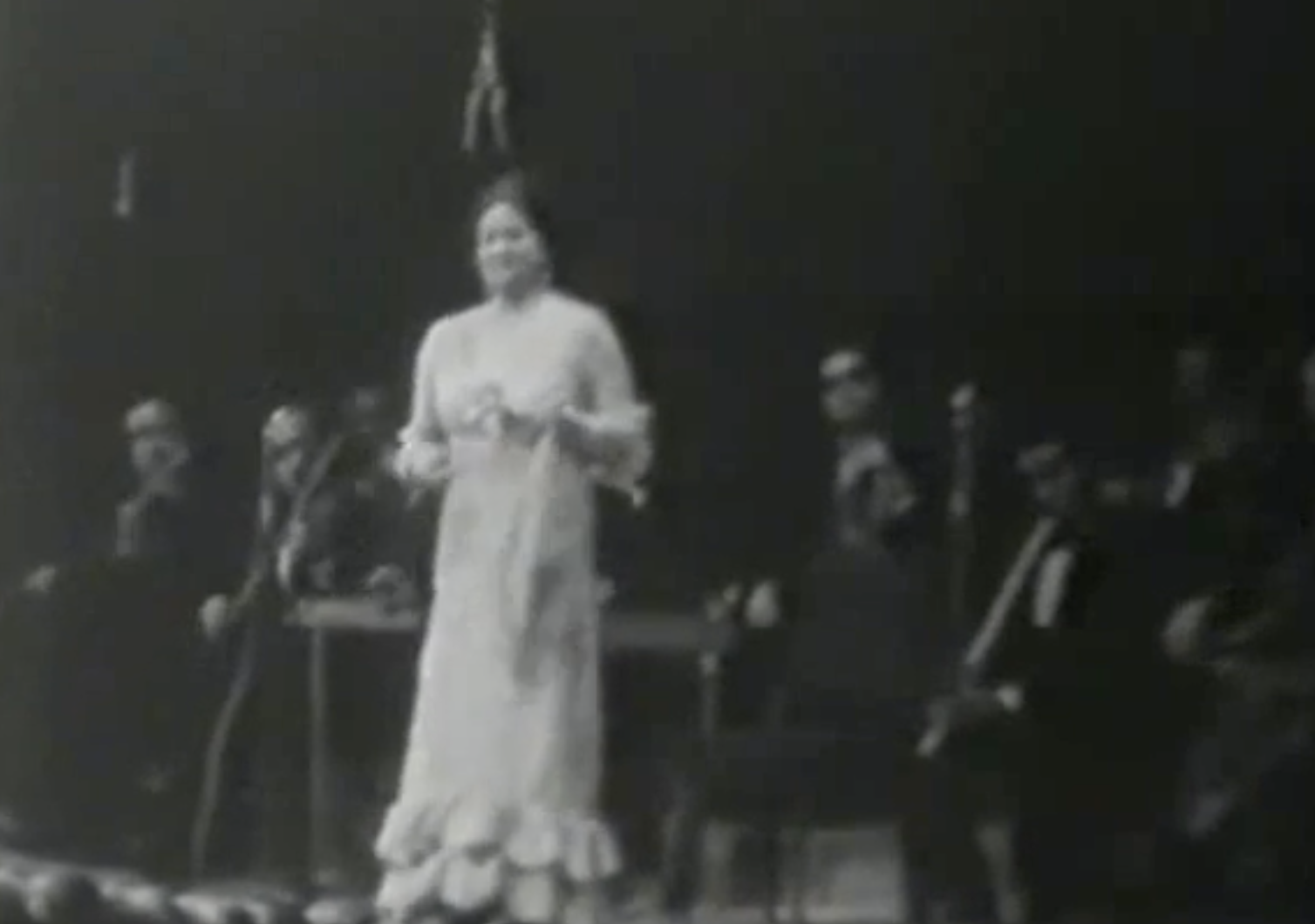
still from Um Kulthoum's concert in Morocco
I heard in a documentary that there were about 47 variations in this performance alone. The legendary concernt Um Kulthoum gave in Morocco in 1968. In those 9 minutes Um Kulthoum modulates between about 7 different scales or modes. For a woman who is pushing well into her sixties, its no small feat to be able to improvise with such virtuosity. It would be one of the last times that Um Kulthoum sings one song for over two hours and improvise using all the tricks in her arsenal. It was also a special occasion, it was her first time to sing in Morocco, and she was received like a queen. She would later say in interviews, that she has never encountered an audience like the Moroccan audience. She described them as 'extraordinary listeners, music is in their blood'. She was happily surprised how they caught up on everything little thing she did and responded with complete, fierce abandon. They gave her everything, and took everything she could have possibly offered as singer, performer, musician, magician! But this is not just to praise the Moroccan audience, or the musical abilities of Um Kulthoum. This is about the nine minutes where Um Kulthoum showcases not only her encyclopedic knowledge of Arabic music and scales, but her innate understanding of the Arabic language and its poetics.
This is about the poetics of Nazra. Nazra is such a complex concept to decipher. As laden with shades of meaning, as Um Kolthoum's singing and improvisation. 'Nazra', is a conscious, directed disposition towards another subject. It is a choice. You choose to 'give' someone 'nazra', like in French, se donner un regard, that is why I think the word, 'regard' in French, is more closer to the meaning of 'nazra'. 'Regard', is a suffix 're' and 'gard', an English version of 'ward', to take care of something, to watch something, to 'guard' it. 'Regard' in that sense becomes to witness yet again, to watch it one more time, to take care of it. And there are many positions and dispositions, one can take in face of the other, one can give Nazra, in a multitude of ways, it can be to 'behold something or someone in a particular manner', as in the English sense, regards, as in remembrance, to remember one's own commitment to the other, it is not just a 'gaze', which to me sounds a bit voyeuristic and distant. 'Nazra', really is to 'behold' someone, and it’s not just the act of directing one's visual perspective towards a subject, no. It is to acknowledge their presence, and hence become responsible for such recognition, the responsibility that creates the commitment, the commitment to 'hold', to 'behold' the other. There is almost a moral binding feeling to the word, 'nazra'. You don't just visually perceive, in the objective sense, you become conscious of this subject and this subject instantly creates or develops an expectation of such recognition. The expectation of 'your' reaction. The reaction that says 'I embrace your existence, for it is forever tied with mine'. Nazra is temporal in its physicality, one's eye perceives in real time, but its timeless in its effect.
That is the expectation that nazra creates. Our destines become entangled because you made the decision to recognize me, you made the gesture, the possibility for this psychic entanglement.
Speaking of recognition, mystics in Islam, wrote a lot about the divine 'nazra', that God 'regards' His faithful. He does not merely, 'see' their bodies and deeds, but He 'regards them in recognition'. And when He 'regards' them, it means He considers them with the eye of kindness and compassion. He acknowledges the misery of mortals and 're-guard' it with grace. Nazra then becomes the intercession on the behalf of the culpable, by the possessor of grace and compassion. Many common prayers that people say at the shrines of saints begin by the word 'nazra'. As in the famous, 'nazra ya set' (set is lady, and it refers to Zaynab bint Ali , the Prophet's granddaughter who some claim lived and died in Egypt and has who has a huge shrine in Downtown Cairo, and is considered by many, as the head of some divine council/intercession) - ironically Um Kulthoum was also called 'el Set', conflating the appreciation of Zaynab with herself, as the giver of penance, the one that consoles her devotees from the burden of their misery - playing on the transcendental and the timeless.
And of course Umm Kalthoum is so frighteningly aware of the mystical dimension of the word 'nazra', she acknowledges the suffering of her listeners, the deep angst of their souls, (for who is not completely lost in the terrible act of love?) and in an ultimate act of compassion, the compassion of el Set, she inhabits their suffering, she embodies it. Not only that, she sings it.
She sings of the potential, hoped for peace, a bilateral acknowledgement of each other's existence and the inner sense of reconciliation one gets from such reciprocity. You see me, not only that, no - you come and cross many boundaries and realms, declaring your conscious desire to surrender, to cede the control of your borders, and ask to enter mine. The ultimate act of reconciliation. Territorial reconciliation. She sings for this ideal condition when we are reconciled with 'the other'.But that moment is fleeting, and fraught with a true human understanding of 'gaze', and not everyone gives us a nazra. Some nazra is a true denial. A denial of promises and vows, of this potential ideal condition of what is yet to be, what can happen, and rather than create the anticipation of reconciliation or peace, it is full of denials and woes. It points out, it reminds us with the terrible consequence when you 'face' someone, when you 'regard' someone, and as we turn and look, we reveal the very essence of our being, the apical act of trust which makes it at the same time, the apical act of vulnerability and thus the supreme act of betrayal.
And between the tentative turning of someone who doubts, and between the mounting anticipation of someone who longs, and between impulsive surrender of someone who wants, and between agony of someone who knows, Um Kulthoum modulates nazra from one scale to the other and from one state to the other.
We are at once faced with the fleeting nature of 'the gaze' and the irrevocable consequences of it, we are faced with initial promise of nazra, as it hesitates and flutters, and then flits and dissolves away, too quickly, leaving us a hundred times more empty and alone. We are slowly beguiled, allured by the many potentialities of nazra, the potentialities that we can feel, that we can perceive, and that we become 'hypnotized' by the existence of such possibilities, and Um Kulthoum mimics the unfolding of those dizzying potentials, she 'hypnotizes' us by revealing the parallel possibility of meaning and tone, one possibility after the other, one variation after the other. And we become enthralled, completely, we are desperate to know, what course, what path, will the nazra take.
But the brutal act of love, cares little for the suffering of our souls. And the patience and perseverance of one longing for 'nazra', is not rewarded by recognition. But rather by humiliation and denial. Our humiliation becomes manifest because we surrender, we declare the very secrets of our hearts, the very desires of our soul, and once known they are refused, snubbed and we suffer the denial and the pain, vowing never again. And yet we still pray for more. We still want Um Kulthoum to sing, we still want her to reveal to us the many layers of nazra, we are not just satisfied with 7 variations, we want a hundred.
But Um Kulthoum died, she too dissolved away, but the effect of her 'nazra' is timeless.